Outdoors at night, water vapour often condenses on cobwebs, on which we can find periodical lines of very small identical water drops. Find the minimum distance between these drops.
Text Solution
Verified by ExpertsCHECK THE SOLUTION.
Sol. Let us compare the surface energy of a cylindrical water thread on the cobweb with that of the periodic water drops formed from the thread. Denote the initial radius of the water thread by r, the 'wavelength' (separation) of the drops by λ and the radius of the drops by R, all as shown in the figure. We can ignore all energies (including gravitational) other than the surface energy of γ per unit area.
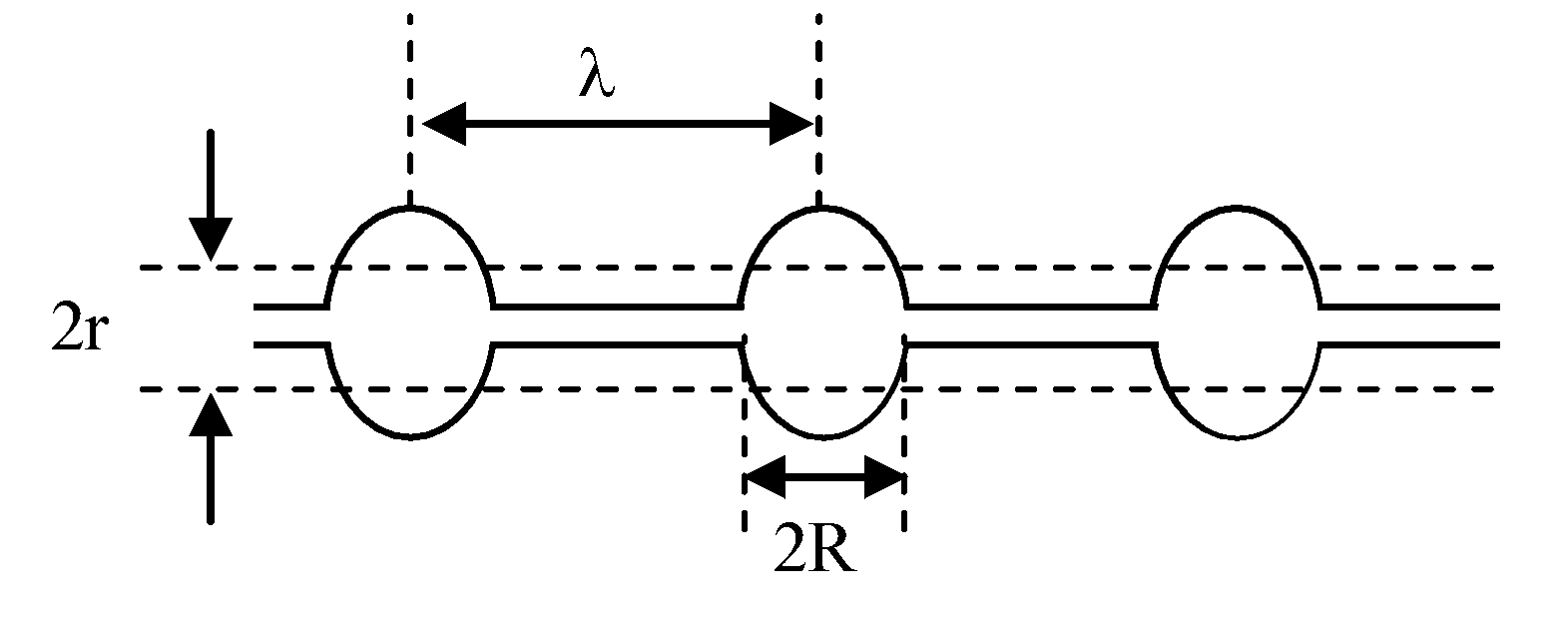
Initially the surface energy of the cylindrical water thread of length L is
E 1 = 2 π rL γ .
Ultimately L/ λ drops, each of radius R, are formed, and their surface energy is given by
E 2 = rpR 2  γ ,
γ ,
where we have ignored the thickness and surface area of the cobweb threads themselves.
The radius R is determined from the conservation of matter.
π r 2 L = 
 .
.
During drop formation the surface energy must decrease, E 2 < E 1 , Eliminating R from these equations, we obtain λ >  r. This result shows that the 'wavelength' of the drops must be larger than a certain critical value λ crit , which is proportional to the initial radius of the water thread.
Prepare Smarter with CGP Edu
Get practice questions, solutions, and test series in one place.
Write a Review
Share your experience with this question and solution.
Commentary
Send your comment, doubt, correction, or feedback to admin.
Similar Questions
Explore conceptually related problems